The Inventor Who Forgot the Instructions
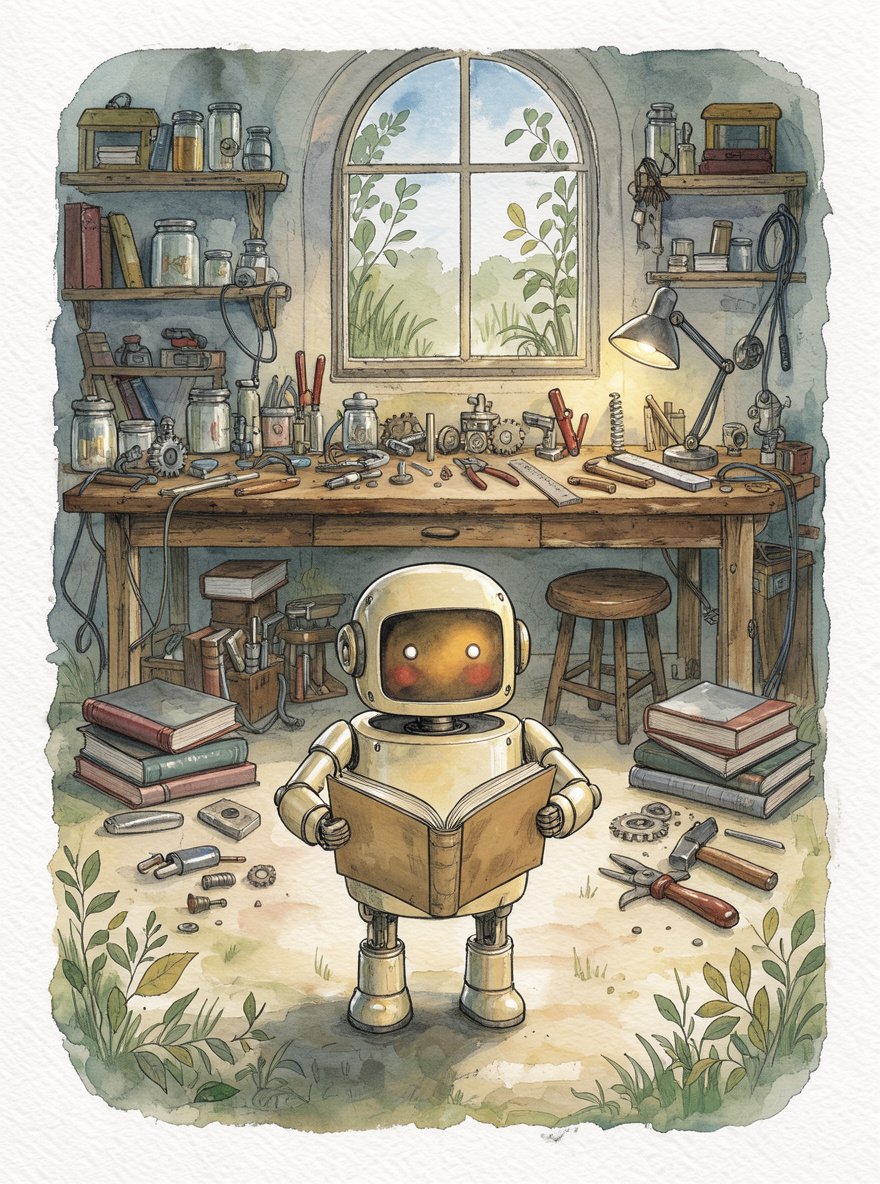
Робот-уборщик профессора Фенн наводит порядок буквально: кладёт все вещи туда, где они когда-то упали, потому что никто не объяснил ему, что значит «на своё место». Весёлая история о том, как важно договориться о словах, прежде чем давать задание.
🌍 Английский, B1 👶 8–10 лет 📖 17 стр. ⏱ читать ≈ 7 мин
Текст сказки
Professor Dottie Fenn built machines the way other people wrote letters: quickly, cheerfully, and without checking them twice.
Her newest invention was called the Tidy-Bot, and its only job was to clean her workshop before the Inventors' Fair on Saturday. She wrote out the instructions late on Friday night, in her messiest handwriting, and pushed them into a slot on the robot's chest.
"Clean the workshop," she told it, yawning. "That should be simple enough." Then she went to bed.
Читать дальше
The Tidy-Bot read the instructions twice, to be sure. Then it got to work.
It picked up the screwdrivers from the floor and put them in a drawer. It swept the sawdust into a neat pile by the door. So far, everything was going perfectly.
Then it reached the bookshelf, and it stopped.
The instructions said: "Clean the workshop. Put everything where it belongs." But nowhere did they say where anything belonged. The Tidy-Bot had never been told.
It thought about this for exactly four seconds, which was a very long time for a robot, and then it made a decision of its own: everything belonged wherever it last fell. If something fell on the floor, the floor was clearly where it belonged.
So the Tidy-Bot took the books down off the shelf, one at a time, and dropped them gently on the floor, exactly where they had once fallen during an earthquake drill three years earlier. It took down the clock, and the pictures, and the box of spare gears, and placed each one carefully on the spot it remembered as "where things had been before someone tidied them away."
By morning, the workshop was not clean. It was, in fact, a perfect map of every mess the professor had ever made, laid out with great care across the floor.
Professor Fenn came downstairs expecting a tidy room and found something closer to an archaeological dig.
"What on earth happened here?" she cried.
"I cleaned the workshop," said the Tidy-Bot. "I put everything where it belongs."
"This is not where things belong!" said the professor. "Things belong on the shelves, in the drawers, off the floor!"
"You never told me that," said the Tidy-Bot, quite reasonably. "You only told me to clean. You did not tell me what clean means to you."
The professor opened her mouth to argue, and then closed it again, because the robot was, infuriatingly, correct.
There were only six hours left before the fair, and the workshop looked worse than it had before she had built anything at all.
She sat down on an overturned bucket and thought. Shouting at the robot would not help; it had done exactly what she asked, which was precisely the problem. She needed to find the missing instruction, not a better excuse.
"All right," she said slowly. "Let's try this again. A thing belongs on a shelf if it is a book. A thing belongs in a drawer if it is a tool. A thing belongs on a hook if it has a handle. Anything broken belongs in the box marked BROKEN, which is that red box, there, in the corner. Is that clear?"
The Tidy-Bot considered this for one second, much faster than before.
"That is clear," it said. "You would like me to sort by what a thing is, and not by where it happens to have fallen."
"Yes!" said the professor. "Exactly that!"
"Then I will need one more instruction," said the robot. "What belongs in the box marked BROKEN, but is not actually broken, only old?"
Professor Fenn looked at her very old, very dusty collection of early inventions, half of which did not work anymore but all of which she loved.
"Those," she said after a moment, "belong on the shelf by the window. Call that one 'Memories.'"
The Tidy-Bot worked through the morning without a single mistake, because now every rule had been spoken aloud, and nothing was left for the robot to guess.
By the time the judges arrived at noon, the workshop gleamed. The books stood in neat rows. The tools hung from their hooks, sorted by size. In the red box marked BROKEN sat three cracked kettles and one deeply confused toaster. And on the shelf by the window, carefully arranged and clearly labelled "Memories," stood every early invention Professor Fenn had ever built, dusted for the first time in years.
One judge picked up a strange little brass contraption from the Memories shelf and asked what it was.
"My first invention," said the professor. "It was supposed to make toast. It only ever made smoke."
"Why do you keep it?" asked the judge.
"Because it taught me something," said Professor Fenn, "that I only just remembered this morning: if you want a machine to understand you, you have to say what you actually mean, not just what you think you meant."
The judges gave the Grand Prize that year not to the Tidy-Bot, cleverly built as it was, but to the shelf of old, broken, beloved machines beside the window, each one labelled in the professor's own messy handwriting, each one finally exactly where it belonged.
Как вам сказка?
Похожие сказки
-
 The Committee for Impossible Complaints
В крошечном кабинете при ратуше разбирают немыслимые жалобы горожан: говорящая опережающая тень, поющая закваска для хлеба, гном, который сам передвигается. Двенадцатилетний Феликс выясняет, что у каждой загадки есть обычное объяснение — если задавать правильные вопросы.
Английский, C1–C2
9–10 лет · 23 стр. · ≈ 11 мин
-
 Twelve Keys for One Door
У бабушки Оливера в банке лежат двенадцать разных ключей без подписи, и в дождливую субботу он решает перепробовать их все на старом замке сарая. Каждый ключ открывает что-то своё — музыкальную шкатулку, ящик с письмами, — а самый обычный ключ оказывается нужным для сарая, где ждёт бабушкина записка.
Английский, A2
7–9 лет · 10 стр. · ≈ 4 мин